Opalite: Anbalaba’s construction company
In Mauritius, the development of real estate projects requires an organisation capable of bringing together a wide range of expertise, while addressing very practical challenges: the availability of skilled labour, the coordination of different trades, meeting deadlines and maintaining the expected level of quality.
In this context, construction is about more than simply carrying out the works. It also depends on the ability to build the right teams, anticipate requirements and ensure effective coordination on site.
This is the approach behind Opalite’s development in Mauritius. Opalite is a construction company operating in Mauritius, delivering residential projects, infrastructure and facilities.
Founded in 2023, the company works in particular on Bouigue Développement’s real estate projects, contributing to the construction of Domaine d’Anbalaba in Baie du Cap. Villas, apartments, infrastructure, facilities and leisure areas: its teams work on projects with a wide range of characteristics, progressively developing their expertise through their involvement in a demanding real estate development.
To better understand the realities of a sector where people-related challenges are closely linked to operational requirements, we met Vadee Juwaheer, HR Manager for Domaine d’Anbalaba and Opalite, who supports the teams and site managers in their development.
Discover in this article Opalite’s expertise, objectives and approach to human resources in Mauritius’ construction sector, through an interview with Vadee Juwaheer.

Meeting Vadee Juwaheer
HR expertise in the construction sector
With a degree in business management and human resources, Vadee Juwaheer has 20 years of experience in the field.
Over the course of her career, she has developed expertise in team management, recruitment, employee relations, training, performance management and talent development.
She has worked in Mauritius’ construction sector for many years, an environment in which people-related challenges are closely connected to the realities of working on site.
Her role includes supporting operational teams and site managers, while seeking to strike a balance between the needs of construction sites, the company’s objectives and employees’ working conditions.
For Vadee, this human dimension is inseparable from the success of a project. “For me, behind every apartment we build, there are first and foremost women and men,” she says. This vision reflects the importance she places on the role of human resources.
Opalite: a human-scale construction company
Opalite was created to contribute to the development and delivery of Bouigue Développement’s real estate projects, including Domaine d’Anbalaba.
The company is involved in the development of Domaine d’Anbalaba and now aims to expand its activity beyond this development, putting its experience to work on projects for external clients.
Its activity mainly covers residential construction, particularly villas and apartments, as well as various types of infrastructure and facilities.
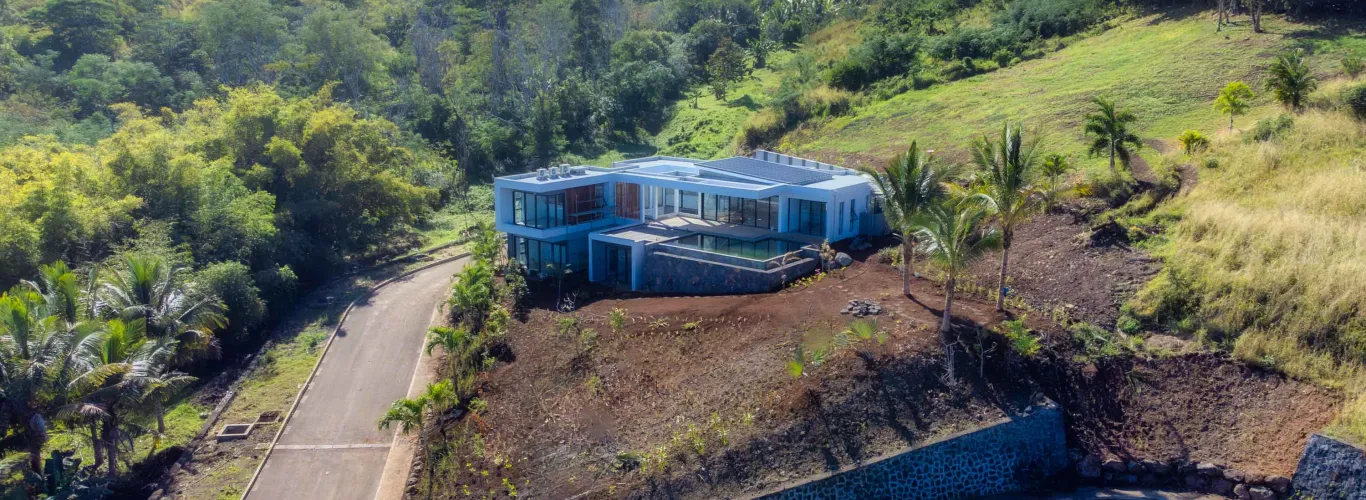
At Anbalaba, Opalite has contributed to the construction of the Pomelo Villas, the Les Vues d’Anbalaba apartments, infrastructure, the restaurant, the security post and the technical area.
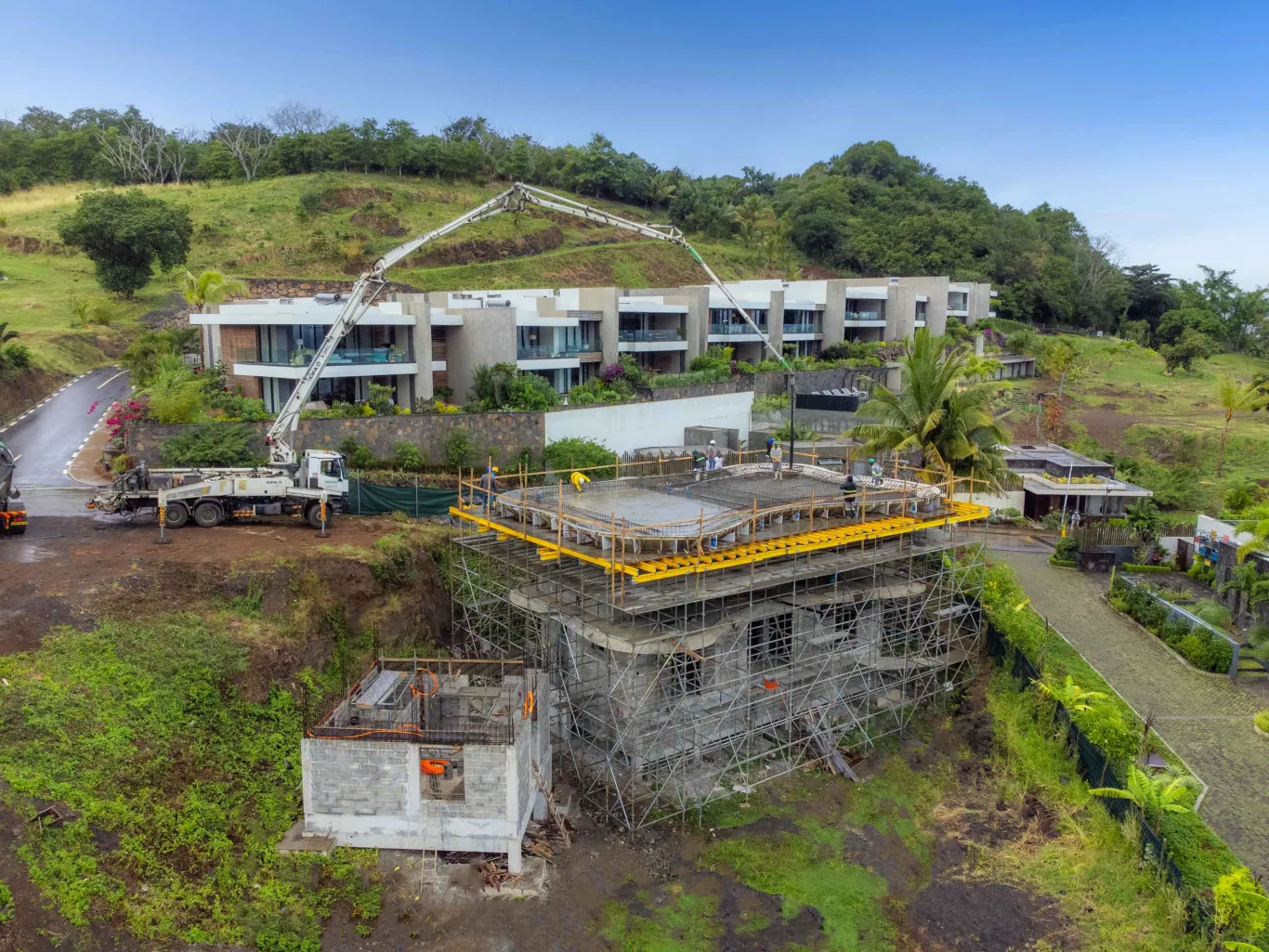
The teams are currently working on several projects, including the first villa in Les Hauts d’Anbalaba, being built on one of the development’s plots, the sports centre and its facilities, including a padel court, and the first Villa Nomadic, a Rivulet model with a green roof. The commercial centre and the construction of the second Villa Nomadic are also among the projects planned.
This diversity allows the company to develop expertise across several areas, including villa and residential complex construction, extension projects, infrastructure works, leisure facilities, swimming pools and renovation.
The teams can work on projects involving roads and water, drainage, telecommunications and electricity networks, as well as irrigation and wastewater treatment projects.
The aim is to maintain a sufficiently flexible organisation to adapt resources to the requirements of each construction site.
Teams with a wide range of skills
A real estate development project brings together a wide range of trades that need to work in coordination to ensure that the different phases of construction run smoothly.
Opalite currently employs 40 people, including 22 expatriate workers.
This diversity of profiles reflects a well-known challenge in Mauritius: the shortage of skilled labour in certain construction trades.
“The construction sector requires a very wide range of skills: engineers, technicians, masons, electricians, plumbers, welders, carpenters, operators, team leaders and many other specialised trades,” explains Vadee. International recruitment helps address the shortage of skilled labour, but should not replace the development of local skills. “The two must be complementary,” she emphasises.
This approach therefore involves both recruiting the specialised profiles needed to ensure that construction sites operate effectively and continuing to develop locally available skills, particularly through training.
Anticipating workforce requirements rather than reacting to them
In construction, the availability of teams can have a direct impact on a project’s progress. For Opalite, the response lies partly in anticipating these needs.
The HR strategy is not to wait until a construction site is facing difficulties before starting to recruit. Requirements need to be identified early enough to find the necessary skills, organise training and plan for potential replacements.
“We need to ensure that projects have the necessary workforce at the right time. A shortage of qualified staff or high staff turnover can have an impact on a project’s progress,” explains Vadee.
This collaboration between HR and the operational teams helps bring people management closer to the realities of construction sites.
The HR function therefore goes beyond administration. It plays a direct role in anticipating the staffing requirements that underpin the organisation and smooth running of projects.
The human factor: a daily challenge on construction sites
Human resources management in construction also involves specific challenges linked to the nature of the work itself: site conditions, physical work, travelling to and from work for some employees, diverse teams and, at times, absenteeism or staff turnover.
In this context, Opalite seeks to maintain close relationships with its employees. The company operates on a human scale, with an emphasis on dialogue and understanding the difficulties encountered on the ground.
Managing absenteeism and discipline therefore requires close collaboration between HR, site managers and supervisors.
“We need to monitor attendance rigorously, but also understand the reasons behind absences,” explains Vadee. For her, discipline is not solely the responsibility of HR: “It starts on site, with the managers who oversee their teams on a daily basis.”
This proximity also makes it easier to identify employees’ needs and work on the conditions that help maintain stable teams.
Remuneration naturally remains an important factor, but it is not the only source of motivation. Recognition, respect, clear responsibilities, opportunities for career development and skills development also contribute to employee retention.
“An employee who understands the value of their work to the project as a whole becomes more than just an executor: they become an active contributor to the project’s success,” says Vadee.
Anbalaba: a demanding environment
Domaine d’Anbalaba has been a particularly significant experience for Opalite.
Developing a large-scale property development that brings together several residential programmes, infrastructure and various facilities requires the coordination of numerous trades and careful planning of the different stages of construction.
The project has also accompanied the evolution of Opalite’s internal organisation, with the arrival of a new management team and a clearer definition of responsibilities.
Objectives are set for different positions, with regular monitoring and a training plan to support the teams. When objectives are not met, corrective measures can be put in place.
This organisation allows the company to progressively strengthen its management and site-monitoring practices.
Building for an international clientele
Another distinctive feature of the real estate projects Opalite works on is their predominantly international clientele, particularly in the case of properties intended for investors under the IRS and RES schemes.
“When welcoming international clients, expectations can be different and often very demanding. This means we need to maintain a high level of excellence and pay close attention to detail, from construction through to delivery,” explains Vadee.
Construction is therefore part of a broader value chain. It is not simply about building a property, but about creating a real estate product designed to be lived in, rented out or used as a second home.
This approach requires collaboration between the construction, sales, administrative, reception, concierge and HR teams.
“Construction is a fundamental stage in the group’s value chain. We turn a real estate vision into a tangible product,” Vadee emphasises.
From Anbalaba experience to external projects
One of Opalite’s current objectives is to continue developing its activity beyond Domaine d’Anbalaba.
The experience gained throughout the development will now enable the company to support other projects in Mauritius, drawing on its teams, organisation and the expertise developed over recent years.
This expansion into external projects also marks a new stage for the management team. The aim is to build on the expertise developed at Anbalaba while retaining the characteristics that make Opalite strong: a human-scale structure, close relationships with its teams and the ability to adapt resources to the needs of each construction site.
For clients and partners, three elements particularly sum up this approach: responsiveness, meeting deadlines and a strong commitment to construction quality.
Human resources: a strategic asset for the future of construction
For Vadee, the evolution of the sector also involves a transformation in the role of human resources.
“I believe HR needs to become increasingly strategic. We need to move from a primarily administrative approach towards one based on anticipation and data,” she explains.
Anticipating skills requirements, identifying trades for which recruitment is more challenging, understanding the reasons behind employee departures and supporting talent development: all these issues go beyond the simple administrative management of employees.
This approach is directly connected to the operational challenges faced by construction companies. A sufficiently large and skilled team, available at the right time and properly managed, contributes to meeting deadlines and ensuring the quality of the work carried out.
For Opalite, this thinking is now part of the company’s development and its ambition to build a team capable of taking on new projects.
“The construction industry of tomorrow will not rely solely on materials and technology. It will also rely on human skills,” concludes Vadee.
This conviction ultimately sums up Opalite’s approach: behind every villa, apartment, infrastructure project or facility lies a succession of different skills, but also teams that need to be able to work together effectively.

Opalite - construction company in Mauritius
Opalite is a construction company in Mauritius that mainly works on residential projects, infrastructure and facilities.
What types of projects does Opalite work on?
Opalite works on the construction of villas and apartments, as well as infrastructure, leisure facilities, swimming pools, renovation projects and various networks.
Does Opalite only work on Domaine d’Anbalaba?
No. The company also aims to develop its activity with clients and on projects outside Anbalaba.
How many people work at Opalite?
The company has around 40 employees, including approximately 20 expatriate workers.
What are Opalite’s main strengths?
Responsiveness, meeting deadlines and a strong commitment to construction quality are among the company’s key strengths.